






 Settings
 Fast Delivery
 Free Shipping
 Incoterms
 Payment Types


 Marketplace Product

Arduino LoRa Project: Control Devices Over Long Distance Easily
2026-04-03 | By Rachana Jain
License: Apache License, Version 2.0 Arduino
Imagine controlling electrical appliances located hundreds of meters—or even kilometers—away without relying on Wi-Fi or internet connectivity. That’s exactly what LoRa technology enables. It provides a reliable, low-power communication method for long-distance data transmission, making it ideal for remote automation systems.
In this project, we build a long-range appliance control system using a combination of BLE and LoRa communication. A smartphone sends commands via Bluetooth, which are then transmitted over long distances using the Reyax module and processed by a microcontroller like Arduino Nano. This setup is especially useful in applications such as smart agriculture, industrial monitoring, and remote infrastructure control.
Components Required
Arduino Nano (2 units)
Reyax RYLR999 LoRa + BLE Module (2 units)
5V Bidirectional Voltage Level Shifter (2 units)
16×2 I2C LCD Display (2 units)
2-Channel Relay Module (2 units)
USB Cable (for programming)
AC Bulb and 12V DC Fan (for load testing)
Reyax RYLR999 Module Overview and Pinout
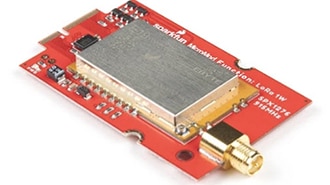
At the heart of this system is the Reyax RYLR999 module, which integrates both Bluetooth Low Energy (BLE) and LoRa communication into a single compact device. This dual capability simplifies system design by eliminating the need for separate communication modules.
From a functional perspective, BLE acts as the user interface layer. A smartphone connects to the module and sends control commands. These commands are then internally routed to the LoRa interface, which transmits them over long distances to another RYLR999 module.
The module features essential pins such as VDD for power, GND for grounding, and RST for resetting the device. It also provides dedicated UART interfaces for BLE and LoRa communication, including transmit (TX) and receive (RX) pins. These serial connections allow seamless integration with microcontrollers and ensure reliable bidirectional communication.
Project Overview / Working Principle
The system is designed using two main units: a controller (transmitter) and a target (receiver).
On the controller side, a smartphone connects to the RYLR999 module using BLE and sends commands such as turning a device ON or OFF. The connected Arduino Nano reads these commands and forwards them through the LoRa interface.
At the receiving end, another RYLR999 module captures the transmitted data and passes it to a second Arduino. This microcontroller interprets the command and triggers a relay module to control connected appliances.
This architecture allows efficient long-range communication without internet dependency while maintaining low power consumption and high reliability.
Hardware Setup Explanation and Connections
The system consists of two similar hardware setups—one for transmitting commands and one for receiving them.
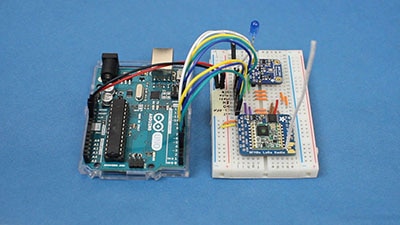
In the controller setup, the RYLR999 module communicates with the Arduino Nano via UART. Since the module operates at 3.3V logic levels and the Arduino uses 5V logic, a bidirectional voltage level shifter is used to safely interface both devices.
The LoRa TX and RX lines are connected through the level shifter to the Arduino’s hardware serial pins. Additionally, BLE communication is handled using software-defined serial pins, allowing simultaneous handling of both communication channels.
An I2C-based LCD is connected using SDA and SCL lines to display real-time system information such as command status and communication feedback.
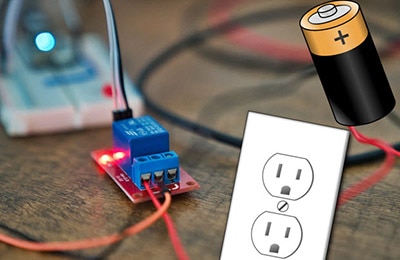
On the receiver side, the setup mirrors the controller but includes a relay module connected to digital output pins. Based on the received command, the Arduino activates the appropriate relay channel to switch appliances such as a bulb or fan. The relay ensures electrical isolation, allowing safe control of both low-voltage and high-voltage devices.
To ensure stable operation, all components must share a common ground, and proper power supply connections should be maintained throughout the system.
Video
Conclusion
This project demonstrates how LoRa communication can be leveraged to build a robust long-range appliance control system without relying on traditional networking methods. By combining BLE for user interaction and LoRa for transmission, it creates a flexible and scalable solution for remote control applications.












 Slovakia